Boys & Girls Club of Malibu, via Nonprophet AI · 2026
Boys & Girls Club of Malibu: discovery that fast-tracked a Nonprofit Cloud build
Led discovery across three programs and helped the organization navigate its platform options. It chose Nonprofit Cloud, and my journey maps and data mapping fast-tracked its scope and build.
The Boys & Girls Club of Malibu runs disaster recovery case management for wildfire survivors, a wellness program with clinical mental health services, and youth programs from after-school to skate camp. The organization wanted an AI assistant, CARA (Care And Recovery Agent), to give staff time back for families. I led the discovery that mapped how staff work across all three programs and compared three platform paths. Together with the organization, I worked through what Nonprofit Cloud offered and helped it choose the path that fit best. It chose Nonprofit Cloud, and my discovery became the starting point for its scope and build.
The problem
Across all three programs, staff spent hours each day on documentation, copy-paste and manual data entry that never reached a family. Case notes lived in long histories that were hard to search. Payments and forms were entered in more than one system. Email wasn’t connected to Salesforce, and funder reports were rebuilt by hand every month. Supervisors tracked follow-ups from memory.
The organization also faced a platform decision. Salesforce had proposed a migration from the Nonprofit Success Pack (NPSP) to Nonprofit Cloud, with CARA built natively on its AI platform. The organization needed to know whether that was the fastest, most sustainable way to deliver CARA before its current disaster recovery funding ended.
My role
Through Nonprophet AI, I led discovery and the platform recommendation. I reviewed Salesforce’s agent and Nonprofit Cloud demos and its proposal with the organization, and ran discovery sessions with the organization’s Salesforce administrator and its director of data and development. I mapped user journeys for all three programs, documented the current Salesforce data model and a draft future state, wrote the care coordinator interview guide, and wrote and presented the path options and recommendation decks. I then sat in on meetings with two implementation partners to plan the next phase.
Approach
One question across three programs. The first ask was framed around disaster recovery, but the same problems showed up in wellness and youth programs. I widened discovery to cover all three, so the decision would serve the whole organization, not one program.
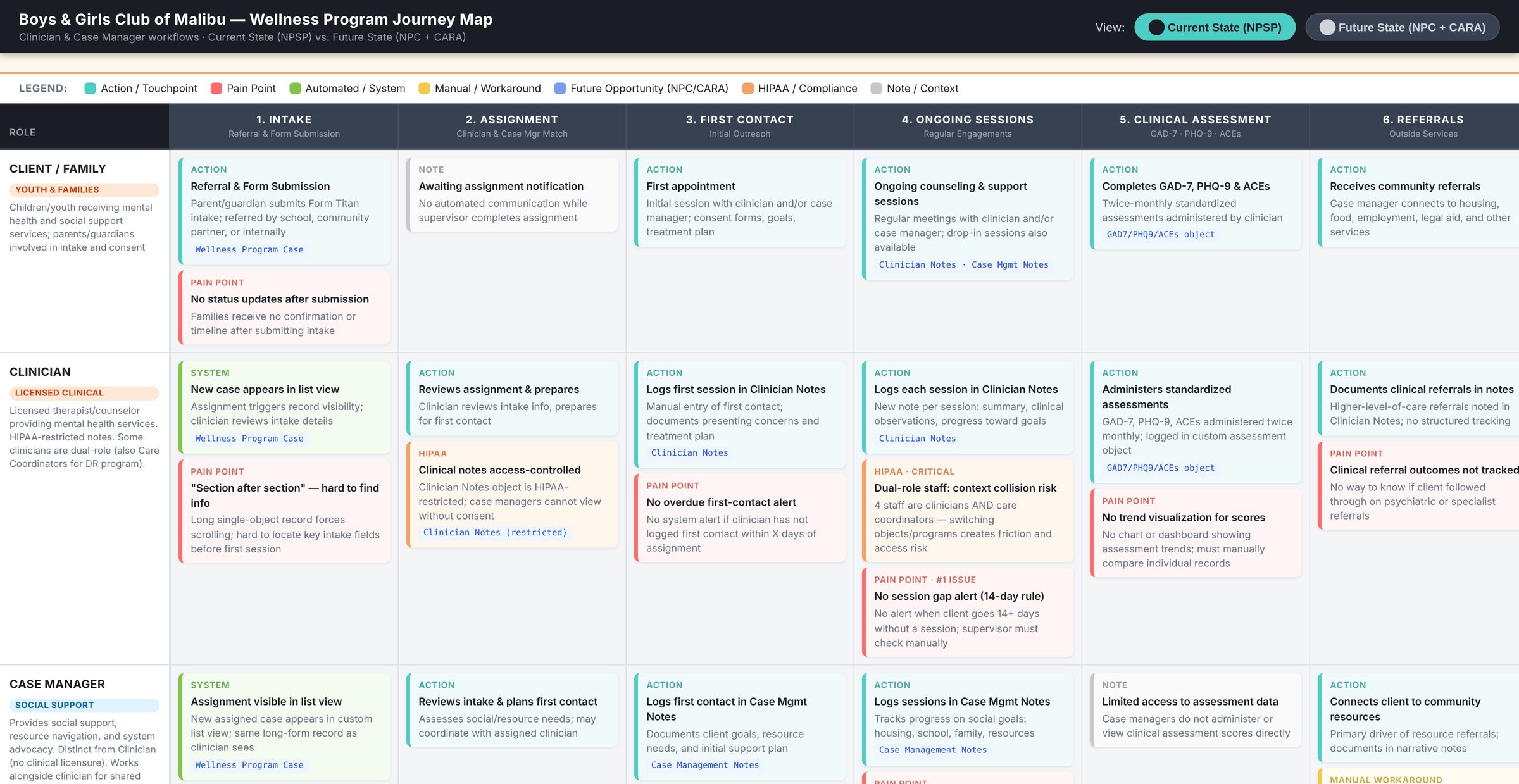
Journeys before platforms. I mapped how coordinators, clinicians and mentors actually work: where they log notes, how they find a fact from months ago, how they fill external aid applications, and how families hear from the organization. I built a journey map for each program, with every role as a lane and each pain point, workaround and opportunity marked on it. For every pain point, I paired what’s broken today with where an AI assistant would help most, and where it wouldn’t. Child pickup verification, for example, is faster as a tap than a conversation, and clinical assessments need a form, not a chat.
The data model behind the workflow. The organization’s Salesforce org had grown to more than 30 custom objects. I documented every custom object and field in a data dictionary, mapped how the disaster recovery objects connect today, and drafted how they would map to Nonprofit Cloud’s native objects. That showed where a migration would be simple and where it would be costly.
Clear criteria. I compared each path against criteria the board could weigh: speed to staff value, the AI capability ceiling, migration risk, licensing and implementation cost, staff adoption, data continuity, future flexibility and reach across all three programs.
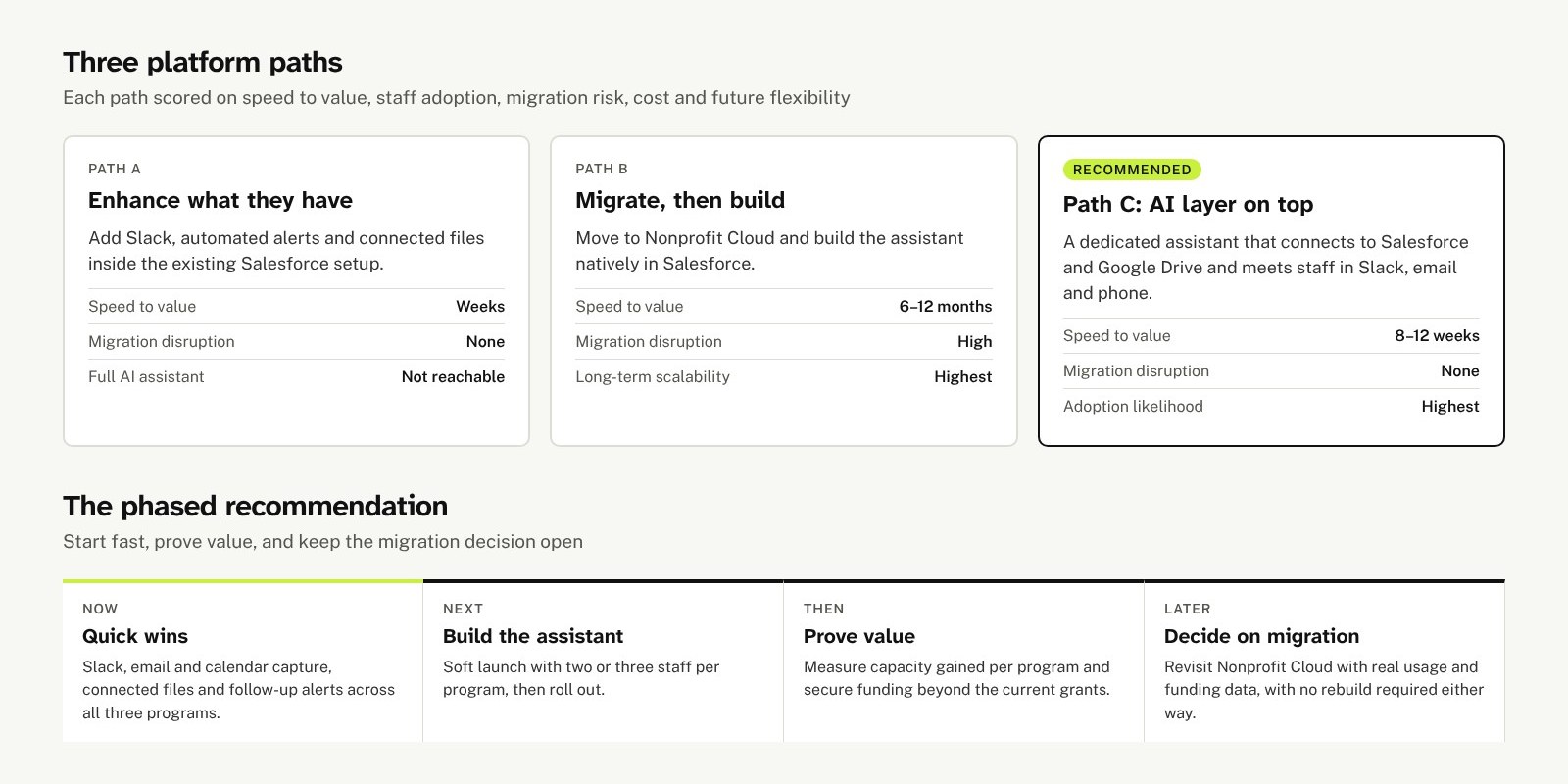
Three paths, side by side. I laid out three options, what each would change in each program, when value would show up, what it was best at and what it couldn’t do:
- Path A, enhance what they have: quick wins inside the current Salesforce setup, with no migration.
- Path B, migrate then build: move to Nonprofit Cloud and build CARA natively, with the cleanest data model but six to twelve months before value.
- Path C, AI layer on top: a dedicated assistant connected to Salesforce and Google Drive that meets staff in Slack, email and on their phones.
Learning the platform together. Nonprofit Cloud was new to the organization, so I worked through Salesforce’s demos, proposal and licensing options alongside the team. As the picture filled in, the trade-offs shifted. A nonprofit discount and new funding brought the cost down, and Nonprofit Cloud’s built-in case management and agent features meant less to build from scratch, so staff could be up and running sooner. With those facts on the table, Nonprofit Cloud became the best fit.
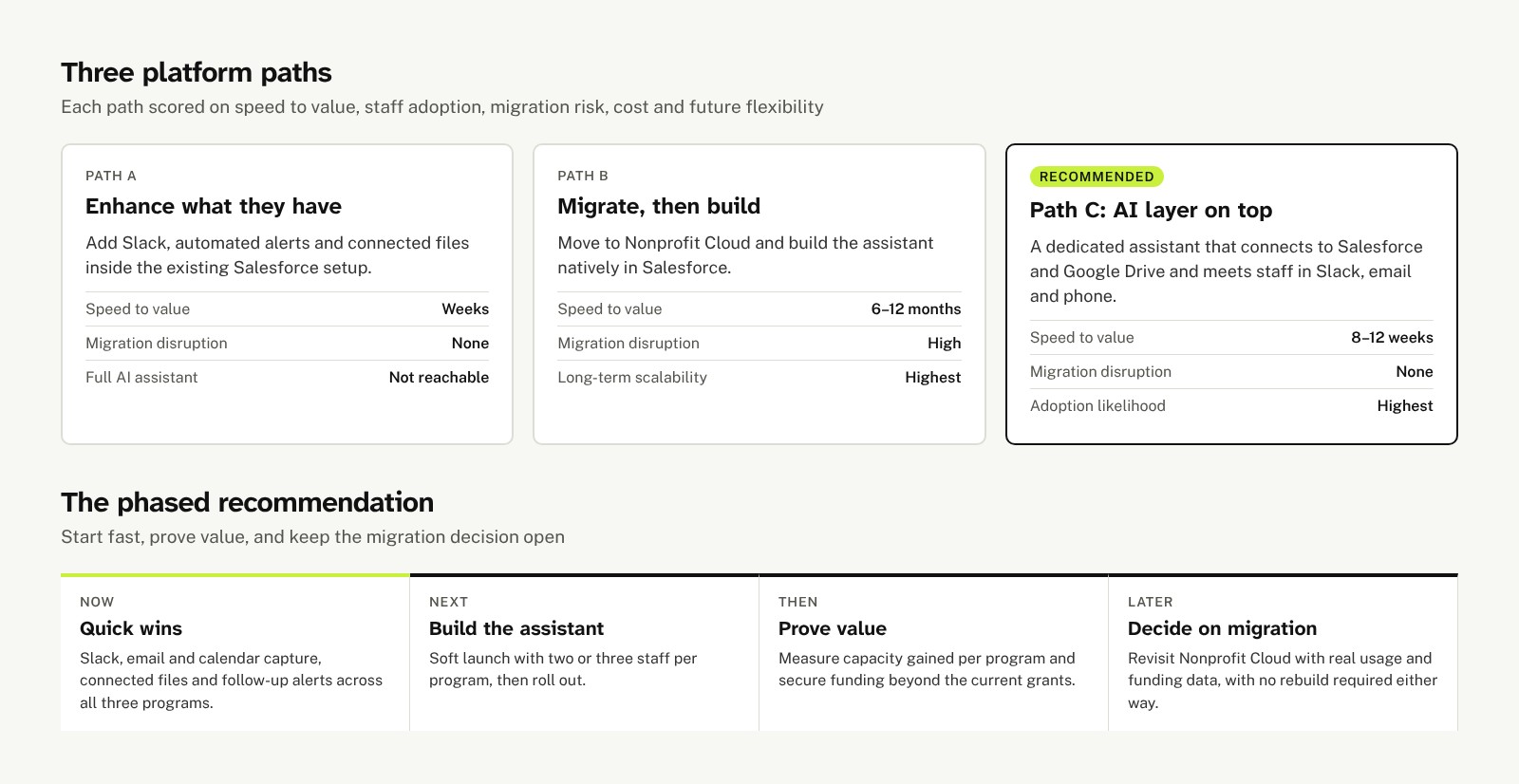
Designed for adoption and privacy. Staff adoption was the biggest risk. I wrote an interview guide for care coordinators and started interviews, so CARA would be designed around how they actually work, not the process on paper. I recommended a soft launch with two or three staff per program, and role-based access so CARA reads only the records each person is allowed to see, which matters for clinical wellness data.
Outcomes
- The organization chose Nonprofit Cloud and Agentforce, with the costs, risks and timelines of every path laid out side by side. A nonprofit discount and new funding made it affordable, and its built-in features shortened the path to staff using it.
- My journey maps, data dictionary and future-state object mapping became the starting point for the implementation scope, so the build began from documented workflows and a drafted data model instead of a fresh discovery.
Reflection
The client and I built a lot of trust in this project. As we learned Nonprofit Cloud and its AI capabilities together, the right path became clear as the facts came in. I built the discovery around journeys, data and pain points first and platforms second, so none of it depended on the decision. When the organization chose to migrate, that work became the foundation for its Salesforce build.